1915 Magazine Renewal Letter Recalls Christmas Past Postal Heritage

1915 Magazine Renewal Letter Recalls Christmas Past Postal Heritage

Global postal celebrations taking place on World Post Card Day on October 1 highlight the enduring power of printed correspondence across international borders. Every year, millions of postcrossing enthusiasts, educators, and letter writers exchange illustrated postcards to honor universal postal service unity. This global celebration underscores how simple paper mailers carry deep personal and cultural connections.
Examining historic commercial covers reveals fascinating postal anomalies that mirror this timeless holiday warmth.
this global celebration demonstrates how physical correspondence brings communities together worldwide.
A classic historical example is a 1915 third-class mail envelope sent by Webb Publishing Co. of St. Paul, Minnesota, promoting renewal subscriptions for “The Farmer’s Wife” magazine.
The envelope featured a printed 1-cent paid indicia placed unusually in the lower-left corner, accompanied by charming festive illustrations of Santa Claus and his reindeer.
While bottom-left indicia placement violated standard postal regulations, holiday spirit led postmasters to allow the mailings through. Inside, subscribers were offered a three-year magazine subscription for 50 cents, complete with a free 1916 Art calendar and 104 Christmas cards, tags seals.
this historical letter shows how publishers crafted compelling holiday offers over a century ago
Historical Context and Release of the 1915 Magazine Renewal Letter Issue
Studying early twentieth-century third-class mailings provides rich insights into the development of American subscription publishing. Independent publishers operating across Colorado, Utah, New Mexico, and Washington D.C. Relied heavily on third-class bulk rates to distribute promotional letters, art journals.
Literary catalogs to rural households in Denver, Salt Lake City, Albuquerque, and D.C.
Archival records stored at the eBay collectible cover auctions document how postal rate categories evolved to support educational and agricultural periodicals. Third-class mail allowed publishers to reach broad national audiences at economical rates, fostering vibrant reading communities across expanding western states. modern independent publishers continue to draw inspiration from these historic circulation strategies.
For boutique magazine publishers and art journal producers today, managing postal logistics requires balancing aesthetic presentation with cost control. Selecting high-grade paper stock and distinctive postage stamps creates an unboxing experience that subscriber communities cherish.
Recommended Bulk Stamp Offers

Design Details and Production Techniques of US Postage
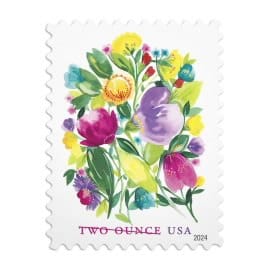
Producing modern postage stamps for literary mailings involves cutting-edge printing technology and premium raw materials. Commemorative issues featuring Flower designs and elegant Wedding motifs utilize fine-screen offset lithography to reproduce delicate botanical illustrations and metallic foil accents with exceptional fidelity.
Technical mailing guidelines on Quora postal advice forums specify precise standards for stamp dimensions, paper weight, and pressure-sensitive acrylic adhesives. Stamps must maintain firm adhesion across various paper grades, ranging from heavy kraft mailing tubes to smooth linen envelopes. Luminescent tagging inks applied during manufacture allow automated postmarking equipment to process incoming envelopes rapidly without tearing delicate covers.
To preserve stamp quality, publishers must maintain optimal storage conditions. Climate-controlled storage facilities kept between 40% and 55% relative humidity (RH) prevent adhesive layers from softening or drying out. Maintaining proper humidity prevents stamp sheets from sticking together or curling, ensuring smooth application during large journal dispatches.
How Business Mailers Benefit from Commemorative Issues
Independent publishing houses face unique fulfillment demands when mailing quarterly literary journals and art prints. Amanda Carter , an independent publisher located in Denver, Colorado, ships signed quarterly art journals to subscribers across Salt Lake City, Albuquerque washington d.c. Ensuring that journals arrive in pristine condition requires selecting correct envelope sizes and accurate postage rates.
Single-ounce letters travel at the standard $0.73 First-Class rate. However, Heavy quarterly journals containing thick art paper and cardboard stiffeners weigh between 2 and 8 ounces. Amanda Carter calculates exact postage requirements, utilizing 2-oz rate stamps for mid-weight packages and Priority Mail options for bulk subscriber cartons.
Priority Mail Flat Rate boxes provide reliable 1-to-3 day delivery with tracking, ensuring art collectors receive signed editions safely.
Amanda Carter has managed independent publishing dispatches for seven years, building a loyal subscriber base through meticulous fulfillment standards.
To elevate publication aesthetics, Amanda selects charming Flower stamps and refined Wedding stamps that match journal cover themes. Furthermore, purchasing bulk Forever stamps in advance shields her publishing budget from upcoming rate hikes, fulfilling 2027 postal rate increase hedging strategies and maintaining stable subscription pricing.
Combining historic postal appreciation with modern bulk stamp sourcing allows independent publishers to deliver beautiful physical media while protecting operating margins.
| Publication Mail Tier | Weight & Size Range | Recommended Postage Option | Subscriber Delivery Experience |
|---|---|---|---|
| Single Sample Issue | Up to 1.0 Ounce | Standard 1-oz Flower Stamp | Clean, professional envelope mailer |
| Standard Art Journal | 1.1 to 2.0 Ounces | 2-oz Rate Stamp / Additional Ounce | Protective cardboard mailer with Flower stamp |
| Deluxe Subscriber Box | Over 2.0 Ounces / Bulk | Priority Mail Flat Rate Box | Tracked box with Wedding stamp accent |
Streamlining Corporate Shipments with Bulk Sourced Postage
Streamlining publication dispatches requires reliable inventory sourcing and disciplined budget management. Publishing professionals who purchase bulk coil rolls and pane postage lock in current unit costs. This ensures Long-term profitability as transport expenses increase.
Active discussions among independent publishers on Wikipedia postal history highlight bulk stamp procurement as a top recommendation for reducing fulfillment overhead.
Sourcing postage from a reputable discount forever stamps store enables publishers like Amanda Carter to buy authentic Flower and Wedding stamps at discounted volume rates. Bulk purchasing ensures that mailrooms in Colorado, Utah, New Mexico, and Washington D.C. remain fully supplied for upcoming publication launches.
In summary, learning from 1915 third-class mail heritage helps modern publishers craft memorable subscriber mailings. By mastering 1-oz vs 2-oz postage calculations, utilizing Priority Mail, keeping stamp inventory in 40-55% RH environments. Securing bulk Forever stamps, independent publishers build lasting connections with readers nationwide.
Frequently Asked Questions
What makes the 1915 Third-Class mail envelope unique
The 1915 third-class envelope sent by Webb Publishing Co. Featured an unusual bottom-left printed indicia and festive Santa illustrations, with modern commemorative stamps available through the forever stamp store for collectors and mailers alike.
How can independent publishers optimize quarterly journal mailing costs
Independent publishers optimize costs by accurately weighing journal mailers to apply exact 1-oz or 2-oz rates, utilizing Priority Mail Flat Rate boxes for bulk orders. Purchasing bulk Forever stamps to hedge against future rate increases.
Why are Flower and Wedding stamps ideal for boutique publication mailings
Flower and Wedding stamps provide an elegant, artistic aesthetic that complements high-end literary journals and art prints, enhancing subscriber unboxing satisfaction upon delivery.
The Evolution of Security Printing and Paper Specifications
To fully appreciate the craftsmanship of modern postage stamps, one must examine the progression of security printing since the mid-20th century. Traditional steel-plate engraving. Meanwhile, Beautiful, was largely replaced by offset lithography and rotogravure to meet the demands of a rapidly growing postal system.
Security paper manufacturers developed specialized papers that incorporate security fibers and watermarks to deter counterfeiters.
Modern stamp paper is designed to have specific absorption characteristics. This ensures That the inks dry quickly and do not smudge during high-speed processing.
The backing paper, or liner, is coated with a release agent that allows the pressure-sensitive adhesive to peel away smoothly.
These technical advancements ensure that each stamp is not only a work of art but also a highly functional component of the national logistics network, designed to withstand the physical demands of transport and sorting.
Strategic Mailing Operations and Financial Planning for Future Rates
For corporate logistics managers, postage is a major operational expense that requires careful planning and budgeting. The United States Postal Service operates on a system of regular rate adjustments to cover the costs of maintaining facilities, upgrading sorting machinery fuel for delivery vehicles. The upcoming 2027 rate increase represents a significant budget adjustment for high-volume mailers.
To mitigate these rising costs, smart businesses pre-purchase large quantities of Forever stamps, locking in current rates for future mailing campaigns.
Sourcing stamps in bulk from reliable online suppliers like the Forever Stamp Store allows companies to manage their inventory efficiently and ensure that outgoing invoices, marketing materials. Administrative correspondence are always franked with professional and authentic postage, protecting the company’s brand image and financial bottom line.
Administrative Sorting and Regional Hub Efficiency
To understand how physical letters transit across the United States, it is helpful to look at the automated sorting hubs managed by the U.S. Postal Service. When a letter is mailed from a regional branch, it is dispatched to a Processing and Distribution Center (P&DC).
These massive industrial facilities use optical character readers to scan zip codes and apply print barcodes.
Envelopes that utilize standard dimensions and standard paper weights travel through these sorting machines at a rate of tens of thousands of items per hour. However, envelopes that are oversized, square-shaped, or contain thick contents cannot be sorted by machine and must be processed by hand. This Incurs extra postage fees.
Sourcing high-quality, pre-sorted stamps and matching envelopes ensures that your corporate mailings comply with automated machinery guidelines, reducing transport delays and ensuring rapid delivery to your clients.
The Evolution of Security Printing and Paper Specifications
To fully appreciate the craftsmanship of modern postage stamps, one must examine the progression of security printing since the mid-20th century. Traditional steel-plate engraving. Meanwhile, Beautiful, was largely replaced by offset lithography and rotogravure to meet the demands of a rapidly growing postal system.
Security paper manufacturers developed specialized papers that incorporate security fibers and watermarks to deter counterfeiters.
Modern stamp paper is designed to have specific absorption characteristics. This ensures That the inks dry quickly and do not smudge during high-speed processing.
The backing paper, or liner, is coated with a release agent that allows the pressure-sensitive adhesive to peel away smoothly.
These technical advancements ensure that each stamp is not only a work of art but also a highly functional component of the national logistics network, designed to withstand the physical demands of transport and sorting.

Currently working at USPS in Chicago, he has more than 15 years of experience in bulk mailing and logistics. His columns focus on Forever Stamp trends, helping businesses and individuals make cost‑effective mailing decisions.